The State of Influencer Marketing Benchmark Report 2024 - Influencer Marketing Hub
The Influencer Marketing Benchmark Report 2024 is our latest overview of the influencer marketing industry. It summarizes the thoughts of more than 3000 marketing agencies, brands, and other relevant professionals regarding the current state of influencer marketing, along with some predictions of how people expect it to move over the next year and into the future.
The world around us has changed considerably over the last few years. The arrival of Covid in 2020 turned much of the world on its head, with enforced lockdowns and scenes reminiscent of a Hollywood disaster movie. By 2024, however, much of the world has learned to live with Covid but struggled to cope with its financial fallout. We still suffer from supply chain disruptions, a chronic shortage of key workers, and creeping inflation threatening to unsettle the global economy. And that doesn't even include the effects of Global Warming, associated climatic effects, and wars raging on multiple fronts.
Unsurprisingly, many businesses have struggled to survive in this new environment. And those that have made it this far need to find new ways to market, so they stand out in the minds of consumers. Creator and influencer marketing appear to be more important than ever for connecting brands with their target customers.
We've also seen major advances in artificial intelligence (AI) and machine learning (ML) in recent years. ChatGPT and other generative AI products have made a significant impact in many ways (not just "Deep Fakes" of Hollywood celebrities) and are now prevalent in many products we use daily. Google is experimenting with making AI an integral part of its search engine. Brands involved in influencer marketing can use AI in most phases of the process, from assisting influencer discovery to creating reports at the end of campaigns. If anything, however, we were surprised by how little change there has been in AI usage this year by the marketers who participated in our study, compared to results over the last few reports.
As well as our annual survey collating data related to the influencer marketing industry, the Influencer Marketing Benchmark Report 2024 also incorporates data from HypeAuditor, and our Diversity, Equity & Inclusion (DEI) in Influencer Marketing: Racial and Gender Inequalities Report.
The State of Influencer Marketing Benchmark Report 2024:
Notable Highlights
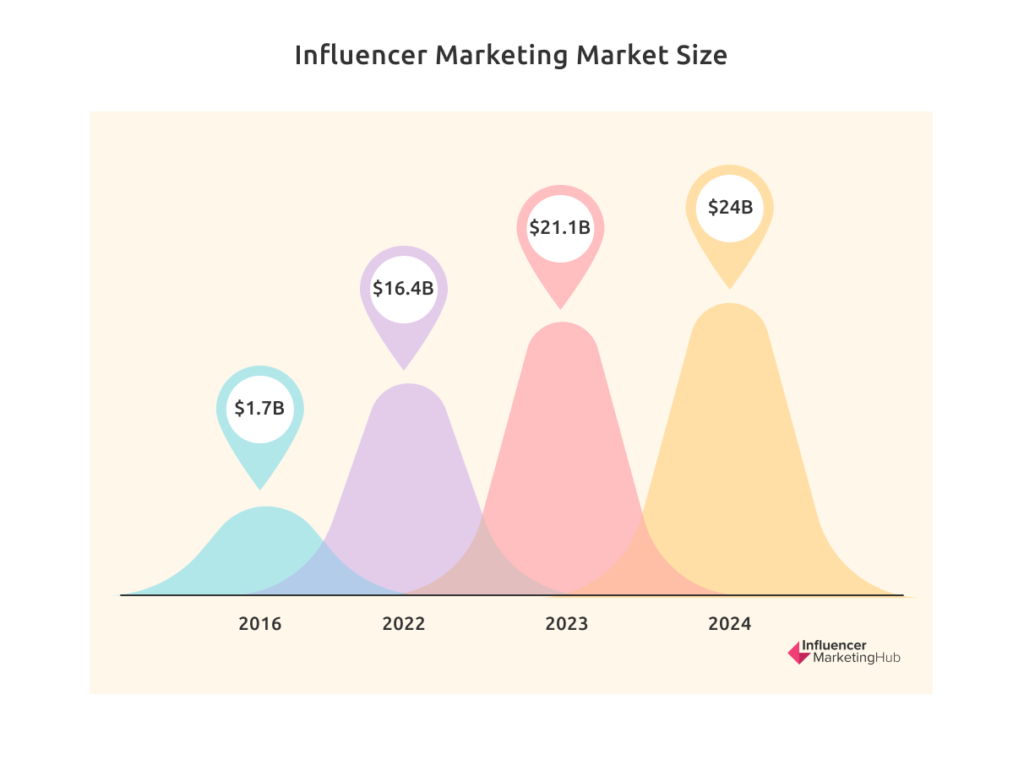
- The Influencer Marketing Industry is set to grow to approximately $24 Billion by the end of 2024
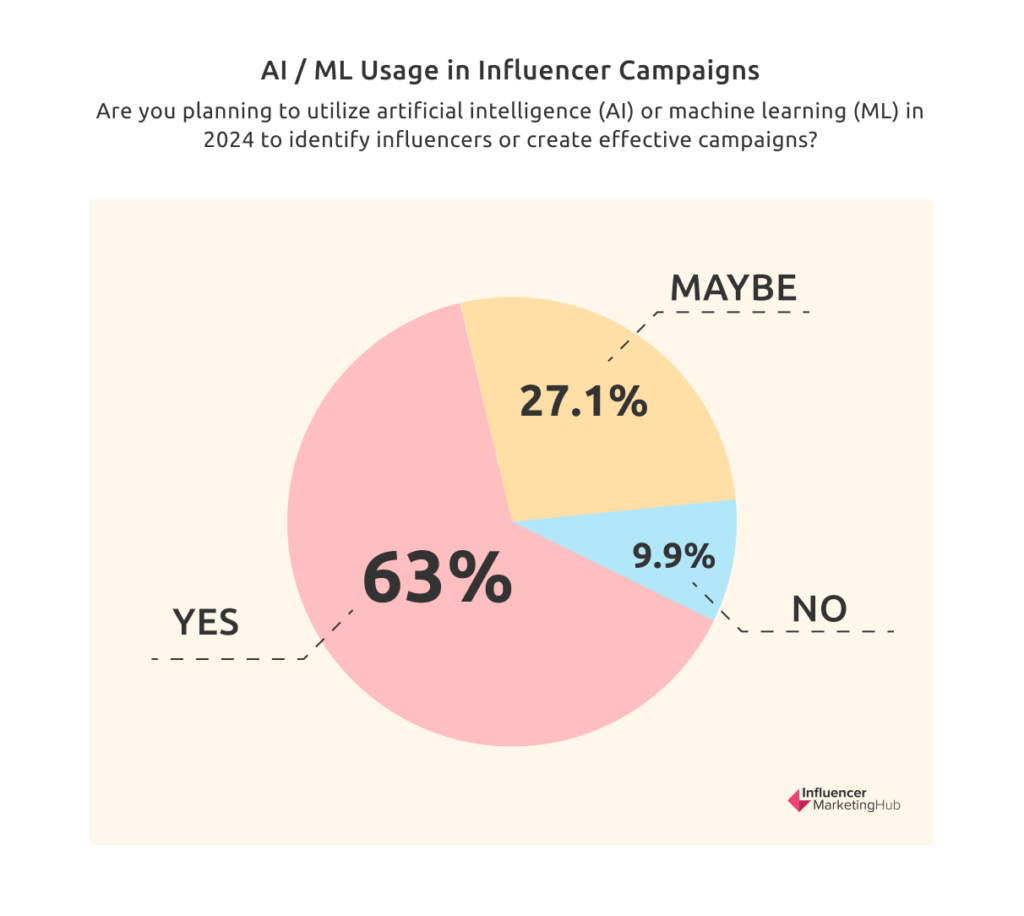
- 63% plan to use AI in executing their influencer campaigns, 55% of these brands will use AI for influencer identification
- 85% of our survey respondents believe influencer marketing to be an effective form of marketing, an increase from previous years
- 75% admit to having increased the amount of content they produce and share
- 60% of those respondents who budget for influencer marketing intend to increase their influencer marketing budget over 2024
- Nearly 1/4 of respondents intend to spend more than 40% of their entire marketing budget on influencer campaigns
- There is a strong preference for working with small (nano - 44% and micro - 26%) influencers ahead of expensive macro-influencers (17%) and celebrities (13%)
- It is now the norm to pay influencers (41%), rather than just give them a free product (31%).
- TikTok (utilized by 69% of brands using influencer marketing) is by far the most popular influencer marketing channel, now well ahead of Instagram (47%), YouTube (33%) and Facebook (28%)
- The main purpose of running influencer campaigns is to create User Generated Content (56%). Generating sales (23%) is a distant second.
Survey Methodology
We surveyed approximately 3000 people from a range of backgrounds. 41.9% of our respondents work at marketing agencies (including those specializing in influencer marketing), and 22.3% consider themselves brands (or brand representatives). 5% are PR agencies. We merged the remaining 30.8% as Other, representing a wide range of occupations and sectors.
In the 2022 and 2023 reports, we saw a relative increase in B2B businesses over B2C firms compared to 2021. However, this year we had a noticeable increase in B2C respondents. 73.1% of those surveyed identify as part of the B2C sector (up from 62%), with the remaining 26.9% (down from 38%) running B2B campaigns.
The most popular vertical represented remains Fashion & Beauty (21.6% of respondents, down from last year's 25%). Gaming became the second-most popular sector (11.9%), followed by Sports (8.6%). Also at 8.6%, Travel and Lifestyle was only two-thirds as popular a category for respondents this year than last. Family, Parenting & Home (7.6%) also decreased representation in 2024. After a big drop last year, Health and Fitness rebounded slightly to a 7.6% share. However, the notable change this year was the expansion of the category we've called Other to cover 34.1% of the respondents (more than any individual category). This covers every other vertical imaginable and signifies the variety of respondents we had for our survey.
We have once again noticed a widespread global response to this year's survey. 19.5% of respondents came from Asia (APAC) (14% in 2023) and another 19.5% came from the USA (16% in 2023). 14% of our respondents come from Africa (31% in 2023), 10% in South America (4% in 2023), and 8.6% from Europe (8% in 2023). 28.5% describe their location as Other (28% 2023). It is highly likely that most respondents who selected Other come from Canada, Mexico, or other parts of North America.
The bulk of our respondents came from relatively small organizations, with 35.6% representing companies with fewer than ten employees. 21.5% had 10-50 employees, 12.3% 50-100, 14.2% 100-1,000, and 16.4% came from large enterprises with more than 1,000 employees. Overall, this spread is very similar to last year's sample.
We've noticed an increase in the percentage of our respondents who operate eCommerce stores compared to those who don't. For example, 57.6% of the respondents run eCommerce stores versus 42.4% not doing so. This represents a noticeable increase in the percentage of influencer-contracting brands operating eCommerce stores. Last year, 51% of such brands ran eCommerce stores.
This is surprisingly high. Remember that our survey respondents come from various backgrounds – brands, marketing agencies, PR agencies, and "Other." Clearly, eCommerce is increasing in popularity for all types of businesses. Website management systems with eCommerce capabilities, such as Shopify, now make it easy for even small businesses to set up an online store. Consumers now expect to do much of their everyday shopping online, and even many traditional brick-and-mortar stores now make this easy.
However, one thing to be aware of is that the Influencer Marketing Hub now caters to all types of online marketing. A more significant portion of the site is now devoted to articles about eCommerce than in previous years. As a result, we may have a higher percentage of eCommerce marketers (compared to influencer marketers) visiting the site and answering our survey than previously.
Influencer Marketing Expected to be Worth $24 Billion by the End of 2024
Despite concerns that influencer marketing (indeed, all marketing) might decrease due to COVID-19, it didn't and has continued to increase in popularity since 2020. Initially, some industries, such as tourism and airlines, had to cut back their operations and marketing, but many others adjusted their models to survive in the post-Covid world. Now there is renewed life in these more Covid-affected industries too.
Over the last couple of years, we have experienced a global economic downturn, and increasing inflation rates, making it more difficult for people to pay for their everyday purchases, never mind perceived extras. Firms must compete more fiercely for the consumer's dollar, pound, or euro. Successful businesses understand the importance of marketing, including influencer marketing, in tough times, and increase their expenditures on this, even when they have to cost-cut expenses elsewhere.
From a mere $1.7 billion at the time of this site's beginning in 2016, influencer marketing grew to have an estimated market size of $16.4 billion in 2022. It was then predicted to jump a further 29% to an estimated $21.1 billion in 2023. Despite these already impressive growth figures, the sector is expected to see even more robust expansion, with Influencer Marketing's Hub predicting the market size to reach an estimated $24 billion by the end of 2024, indicating strong ongoing growth momentum in influencer marketing despite challenging economic conditions.
Results From Our Survey
Sizeable Increase in Content in Recent Years, Rate Increasing After Covid Lull
We asked our respondents whether they had increased content output over the last two years. A sizable 78.5% of them admit to having upped the amount of content they produce. This is up on last year's 71%.
After a small fall in increased content last year, most firms realize the insatiable demand for online content. The majority of marketers have increased their content marketing, year after year. Much of this increase in content must be created and delivered by influencers on behalf of brands.
The types of content shared have changed over time, however. Our most recent Social Media Marketing Benchmark Report found that the most common types of posts on Facebook are now link posts (49.2%), followed by photo posts (30.8%), video posts (17.7%), and in a distant last, status posts (2.3%). On Instagram (business accounts) photo posts (41.7%) are the most popular, followed by video posts (38.2%), and carousel posts (20.0%). Alongside these platforms, the popularity of YouTube has led to a demand for more video posts, and the success of TikTok (and its rivals like Threads) has seen a notable shift towards short video content.
An Increasing Majority Have a Standalone Budget for Content Marketing
Nearly 2/3 (65.8%) admit to having a standalone budget for content marketing. This figure creeps up each year and is up from 63% last year, 61% in 2022, 59% in 2021, and 55% in our 2020 survey.
These figures compare with a surprising finding from HubSpot that just 29% of their marketer respondents actively use content marketing, but 50% of marketers plan on increasing their investment in content marketing in 2024.
Nearly 2/3 of Respondents Felt the Impact Of 2023's Macroeconomic Woes
The world economy is currently in its most challenging situation since the arrival of influencer marketing. So, it was interesting to see whether the Marketing Departments at our respondent businesses are feeling the pinch. Indeed, 64.7% of our respondent businesses say they felt the impact of macroeconomic circumstances during 2023.
The Vast Majority of Respondents Believe Influencer Marketing to be Effective
Unsurprisingly, considering the overall positive sentiment expressed about influencer marketing, just over 84.8% of our survey respondents believe influencer marketing is an effective form of marketing, up from 83% last year.
This statistic has exceeded 80% in each of our surveys since 2017, however, it is still lower than 2022's 90% support. It is clear that most firms that try influencer marketing are happy with the results and are willing to continue with the practice. However, most influencer marketing partnerships work and result in a win-win situation for all parties.
More Than 85% of Our Respondents Intend to Dedicate a Budget to Influencer Marketing in 2024
The general satisfaction felt by firms that have engaged in influencer marketing seems to flow through to their future planning. For example, 85.8% of our respondents indicated that they would be dedicating a budget to influencer marketing in 2024.
This is a moderate increase from last year's 82% result and considerably up from the 37% who claimed they would dedicate a budget in our first survey in 2017. This continuing increase could result from firms increasing marketing to combat the effects of the current global financial crisis and other negative consumer sentiment.
Nearly 60% of Respondents Intend to Increase Their Influencer Marketing Spend in 2024
59.4% of those respondents who budget for influencer marketing intend to increase their influencer marketing budget over the next 12 months. An additional 22.1% indicate that they expect to keep their budgets the same as in 2023. A further 9.3% stated that they were unsure how their influencer marketing budgets would change. This leaves just 9.3% intending to decrease their influencer marketing budgets.
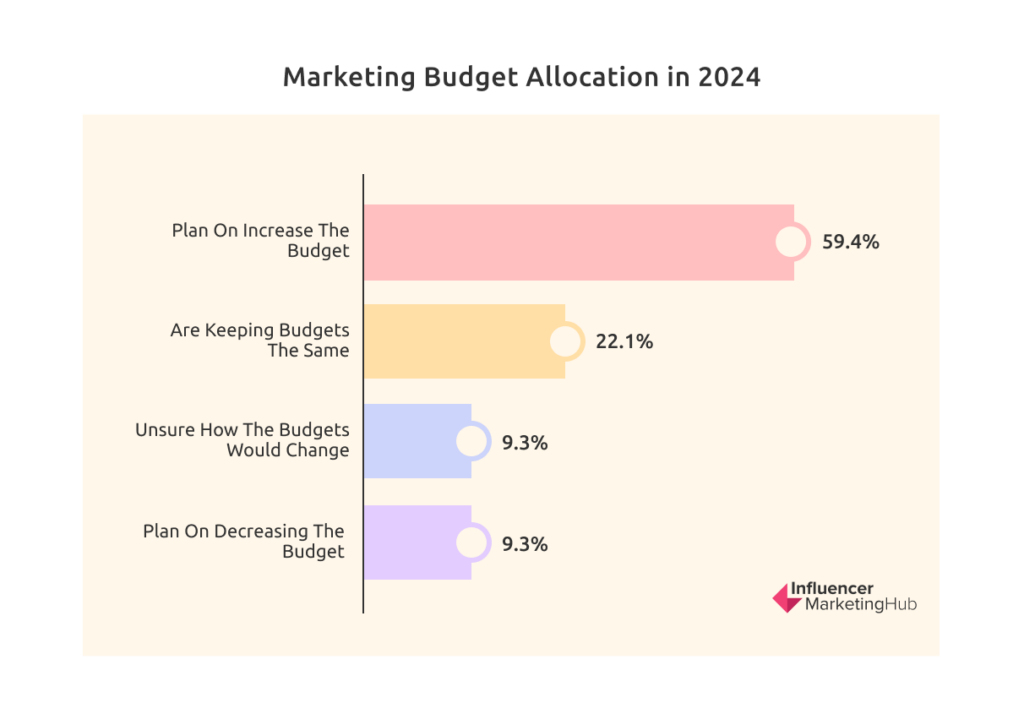
These results suggest a sizable spending on influencer marketing in 2024, although at a slower rate than last year. The 9.3% planning to decrease their influencer marketing budget is slightly higher than last year's 7% figure.
Although this is still proof that influencer marketing continues to be successful and is now sufficiently mainstream that it can't be considered just a fad, it may indicate that budgets are stretched in these tough economic times, with some needing to find savings. Brands and marketers still recognize the effectiveness of influencer marketing, however, and don't appear to be searching for something new. Further evidence of this can be seen in the next statistic.
26% of Respondents Intend to Spend More Than 40% of Their Marketing Budget on Influencer Marketing
Influencer marketing is, of course, merely one part of the marketing mix. Most businesses balance their marketing budget across a wide range of media to reach the greatest possible relevant audience. However, as we saw above, nearly 86% of our respondents' firms intend to include some influencer marketing in their mix.
We notice a continuing trend in firms devoting a sizable percentage of their marketing budget to influencer marketing. Clearly, quite a few brands have found success with their influencer marketing and decided to return for more.
24.2% of respondents are dedicated fans of influencer marketing, intending to spend more than 40% of their marketing budget on influencer campaigns. This is comparable with 2023's 23%, but much increased upon 2022's 5%, 2021's 11%, and 2020's 9%.
11.5% of respondents (down from 13% in 2023) intend to devote 30-40% of their marketing budget to influencer marketing. An additional 15.8% plan to allocate 20-30% of their total marketing spending to influencer marketing.
22.4% of respondents expect to spend 10-20% of their marketing budget on influencer marketing this year. 26.1% expect to spend less than 10%, which is higher than last year's 20%.
Although Most Brands Spend Less Than $50K on Influencer Marketing, Nearly 15% Spend Over $500K.
Brands of all sizes participate in influencer marketing. Therefore, it should be no surprise to see quite some variation in what firms spend on the activity. 47.4% of the brands surveyed said they spend less than $10K annually on influencer marketing (higher than last year's 43% - these are probably a mix of newcomers dabbling with influencer marketing combined with more seasoned marketers operating with reduced budgets). 20.9% spent between $10K and $50K (down from last year's 22%). A further 8.9% spent $50K to $100K (noticeably lower than 2023's 14%), 8.3% $100K to $500K (down from 10%), with a sizable 14.5% spending more than $500K (up from last year's 11% nearly 4x more than in 2022).
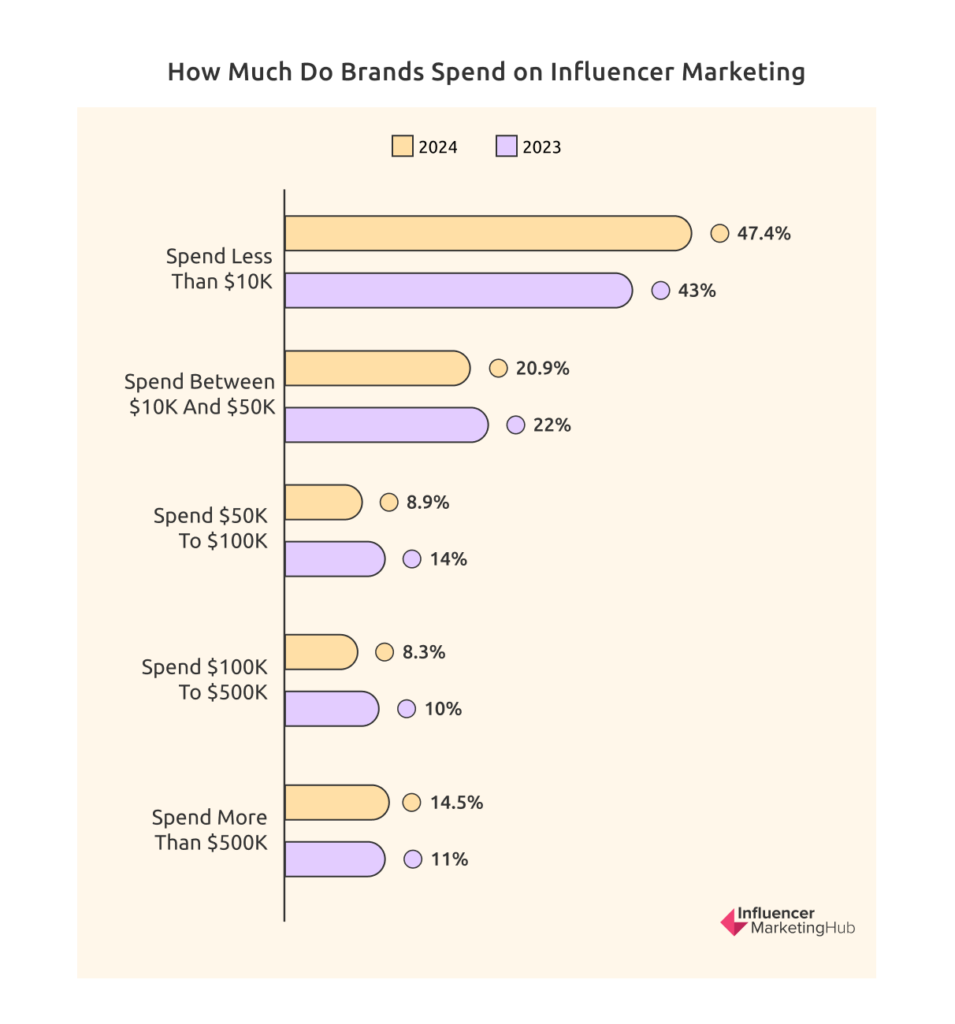
Clearly, the amount that a firm spends depends on its total marketing budget affects the proportion it chooses to devote to influencer marketing. Those brands that opt to work with mega-influencers and celebrities spend more than brands that work alongside micro- or nano-influencers. In 2022 we saw a leveling out of influencer marketing spending, with most brands spending a middling proportion of their marketing budget on influencer marketing. Last year, however, brands moved their spending sums to the extremes. Brands with happy influencer marketing experiences increased the percentage of their marketing budget they spent on the activity. However, brands that experienced less happy outcomes decreased or eliminated spending on the activity, turning their attention to other forms of marketing. This year saw a small movement back towards a more balanced pattern of spending.
Firms Value Working with Influencers They Know
We asked our respondents whether they had worked with the same influencers across different campaigns. The majority, 63.2% (61% last year, 57% in 2022) said they had, versus 36.8% (39% last year, 43% in 2022) who claimed to use other influencers for their campaigns (or perhaps had only had one campaign so far). We can now see a clear pattern of brands preferring to work with influencers they know.
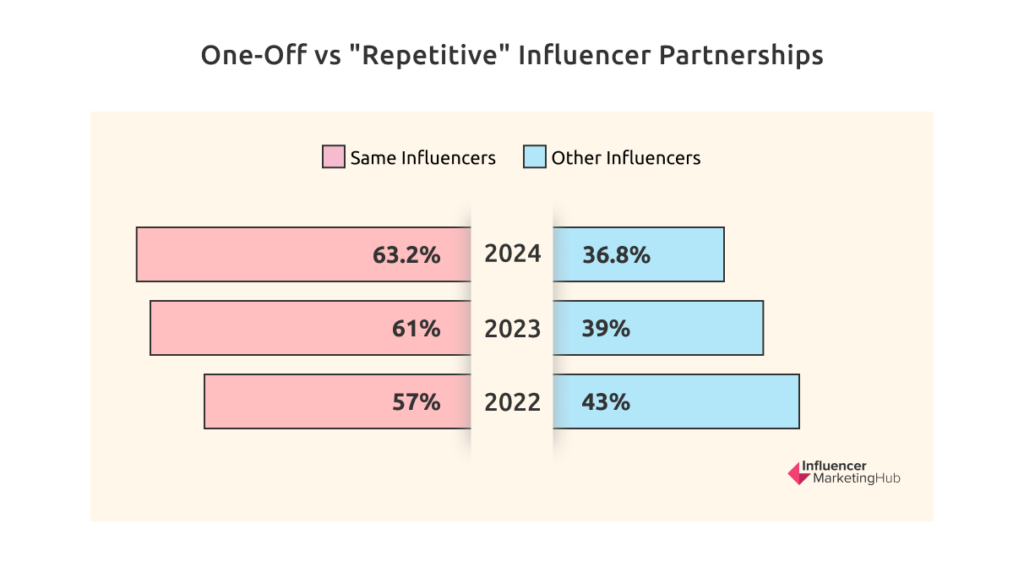
Clearly, brands prefer to build relationships with existing influencers rather than go through the entire influencer selection process every time they run a campaign. Of course, some firms will have a range of influencers they call upon depending on the nature of a particular campaign, the products they are trying to promote, and the target market. The 2% increase in firms working with existing influencers probably indicates the natural increase in influencer-business relationships over time. The more successful an influencer campaign is, the greater the likelihood that the parties will want to work together on other campaigns.
More Than 60% Plan to Use AI or ML in Their Influencer Campaigns
Technology is coming to influencer marketing. Artificial Intelligence (AI) and Machine Learning (ML) have been headlining the news often over the last year. We asked our respondents whether they planned to utilize AI and ML over the next year to identify influencers or create effective campaigns. A very sizable 63% said they would, alongside 27.1% who thought they might. Only 9.9% gave an unequivocal no to this question. Clearly, AI and ML have hit the mainstream.
The Main Purpose of AI/ML Is for Influencer Identification
We asked those who said they would (or might) use AI/ML in their influencer marketing how they intended to use it. The most popular suggestion (55.8%) was using social media data analytics to identify the most effective influencers for a particular brand or campaign. Although the respondents didn't clarify this, they presumably intend to work with one of the many influencer platforms offering influencer identification technology.
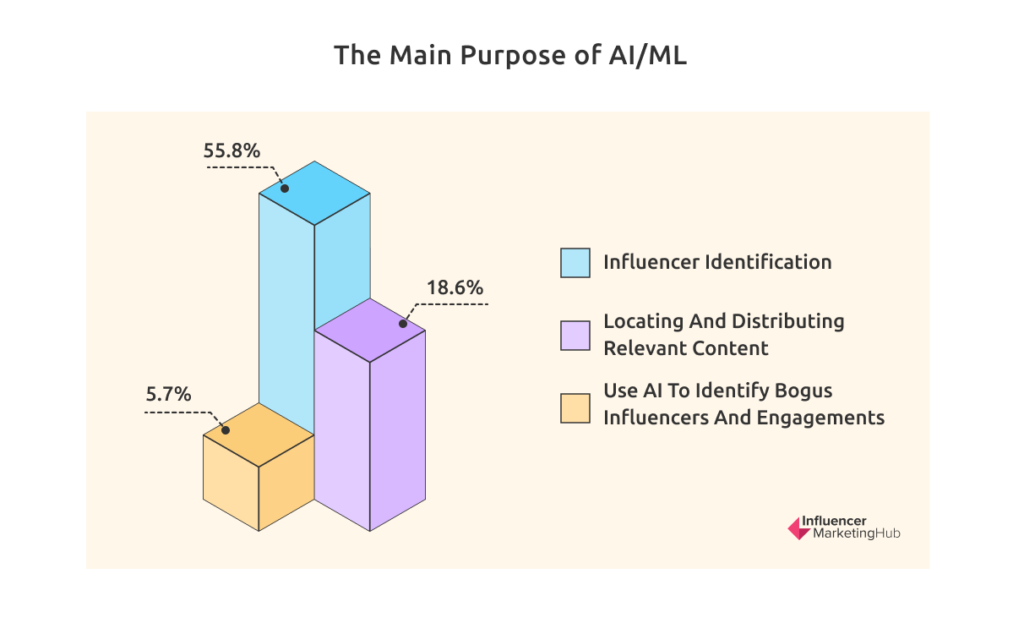
Although somewhat less common, the second most popular intended use of AI in influencer marketing is locating and distributing relevant content (18.6%). The popularity of this has noticeably increased from last year's 13.3%.
Interestingly, 5.7% of our respondents intend to use AI to identify bogus influencers and engagements, an almost identical percentage as in last year's results. It will be interesting to see if this figure rises over time, as more people discover what AI can achieve.
TikTok Still Expected to Deliver the Best ROI for Short-Form Video
Until recently, the name TikTok was synonymous with short-term video, although ardent Snapchat fans may dispute this assessment. However, existing social media companies, YouTube and Meta (Facebook/Instagram) have been hit by the popularity of comparative newcomer, TikTok. Just as Instagram introduced Stories to try and neuter Snapchat, these older social channels have now introduced TikTok-killer features. You will undoubtedly notice YouTube Shorts, Instagram Reels, and even Facebook Reels in your feeds.
For the second year running, we asked our respondents about which they believed would deliver the best ROI (although we didn't show Facebook Reels separately in our survey options). Last year we saw a surprisingly close battle for the top position between TikTok (42%) and Instagram Reels (34%).
This year, however, TikTok has reasserted itself at the top, with 50.1% support, ahead of 29.9% for Instagram Reels. A much reduced 12% believed YouTube Shorts would deliver the best ROI, alongside the usual diehard Snapchat disciples, with 8% opting for Snapchat Spotlights (who would undoubtedly point out that support for their platform has increased 33% from last year's 6% figure). We won't mention the words "margin of error" too loudly.
Strong Preference for Smaller Influencers
We asked those of our respondents intending to work with influencers this year the size of influencer (in terms of followers) they were most likely to utilize. If they used more than one type, they had to pick their preferred option.
44% of brands chose nano-influencers (1K-10K followers) as their most likely partners (up from 39%), followed by 25.7% opting for micro-influencers (10K-100K) (down from 30%).
Far fewer brands choose to place their focus on larger influencers, with 17.4% opting for macro-influencers (100K-1M) (down from 19%), and 12.9% mega / celebrity influencers (up slightly from 12%).
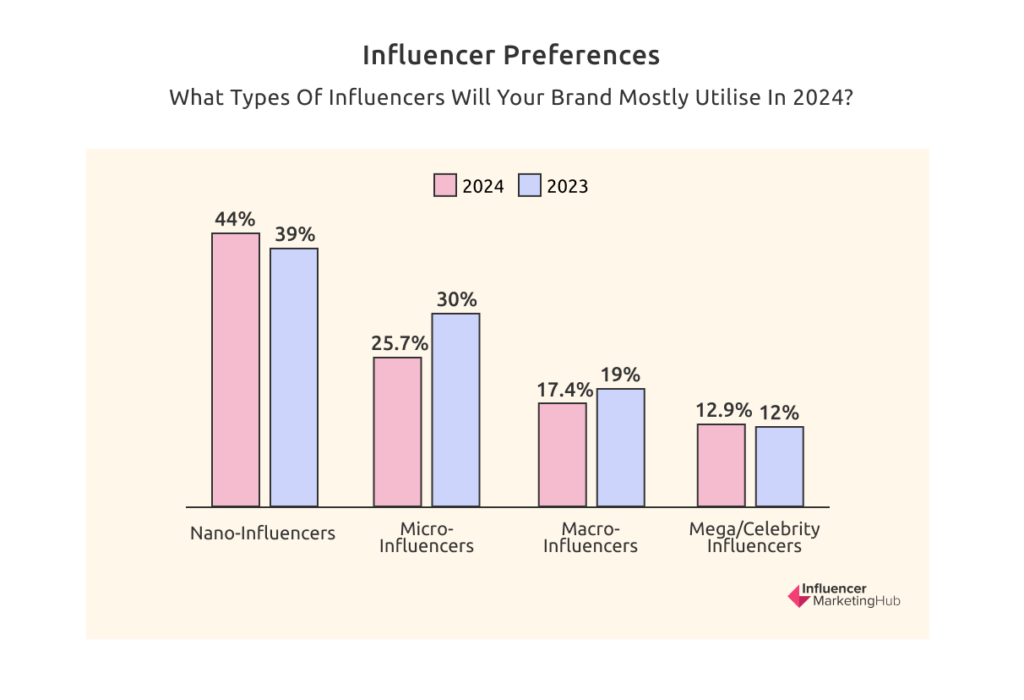
This possibly reflects the reality of a small to medium-sized business. You simply can't afford the fees charged by macro and mega-influencers. In addition, there are far fewer of these more popular influencers, limiting the number of brands they can work with. However, it may also reflect that nano and micro-influencers have far higher engagement rates than their more famous counterparts and may be better value for money for brands wanting to reach a specific dedicated audience.
More Brands Now Pay Influencers Than Give Them Free Product Samples
There has been a notable change in the answers to this question over time. Previously, those giving free samples outnumbered those paying cash to influencers. In 2022, numbers were approximately equal. However, last year, noticeably more respondents stated that they pay money to influencers, than give them free products. This trend has continued with 40.8% offering monetary rewards, 30.8% giving free product samples, 18.9% giving their influencers a discount on their product or services (presumably more expensive items), and a smaller 9.4% entering their influencers in a giveaway.
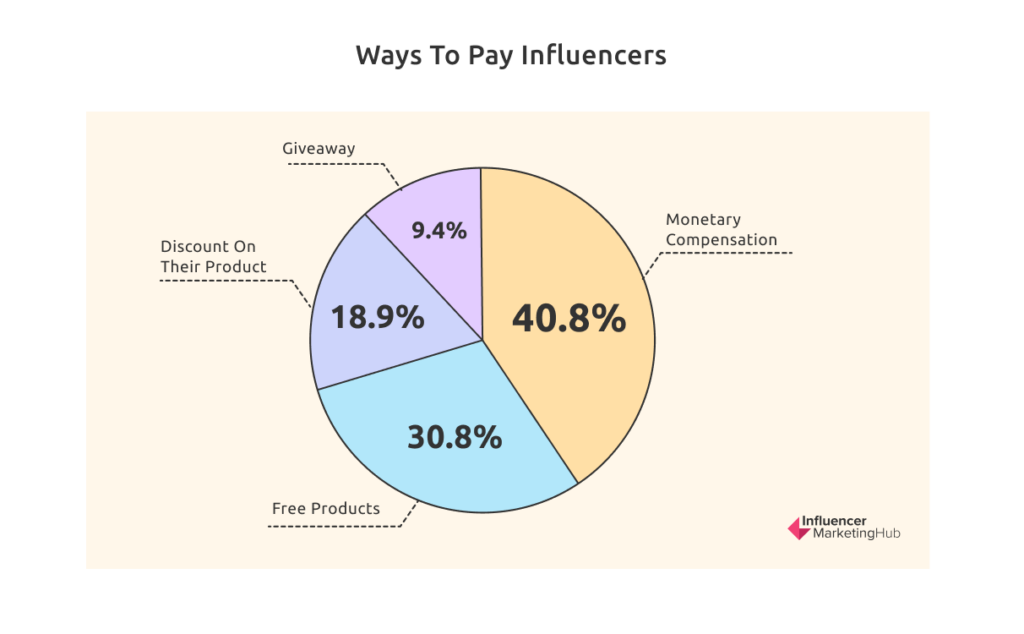
While more brands are willing to pay influencers for their marketing services, 40.8% is still a relatively low percentage, much less than half. It is probably a sign of just how many firms work with micro and nano-influencers. These relative newcomers are happy to receive payment in kind rather than cash. Presumably, it is mainly larger firms with more sizable marketing budgets that pay influencers with money. However, this is gradually changing as even nano and micro-influencers begin to understand their worth as advocates for a brand.
Major Change in Payment System This Year: Half of the Payments to Influencers are Made as a Percentage of Sale
As we prepare the State of Influencer Marketing Benchmark Report annually, we don't generally tend to see major changes in survey results each year. In most cases, movement is evolutionary rather than revolutionary. However, this question saw a significant change in 2023 that has continued this year.
Back in 2022, the most common method (49.6%) was to pay at a flat rate. However, a sizable percentage of other brands (42%) structured their influencer marketing payments more like affiliate marketing payments by paying a percentage of any sales made as a result of the influencer marketing. Payments based on product level (4%) and tiered incentives (4%) were less common.
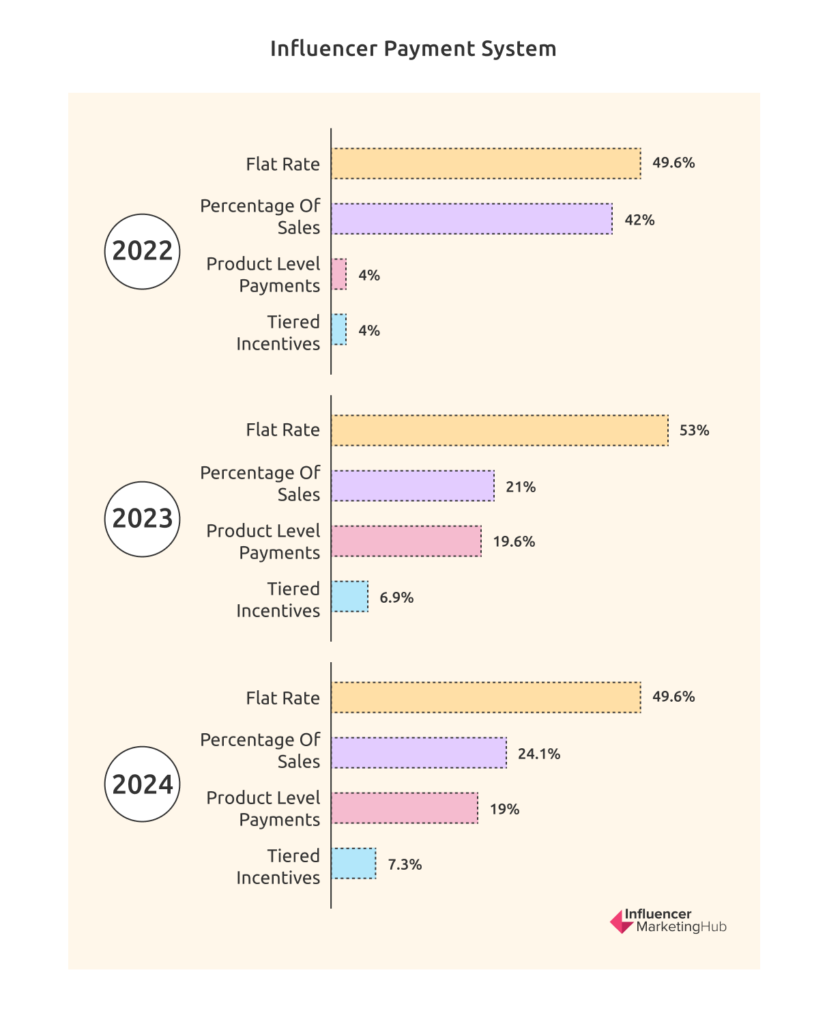
For the last two years, however, things have changed considerably. The most common method (49.6%) now is paying as a percentage of sales value. Flat rate payments now just represent 24.1% of sales, with sales based on product level (19%) now five times as popular as in 2022. Those paying by tiered incentives remain low at 7.3%.
It's hard to understand the reason for such a significant change. Perhaps in these tough economic times brands require a higher level of evidence for the effectiveness of their influencer marketing spending. Possibly more brands engaging in influencer marketing have made increased sales the goal of their campaign, and fewer targeting brand awareness. It will be most interesting to see if this becomes a permanent change.
Wire Transfer is Marginally the Most Popular Way to Pay influencers, However, Other Methods Are Almost as Common
Isolating those respondents who pay money to influencers, we asked them their preferred payment method. 29.2% chose wire transfer (up from 28% last year), 27.2% paid by PayPal (29% last year), 25.1% said they paid manually (25% last year), and 18.5% a third-party payment service, e.g., Wise (17% last year). Manual payments include payments made by cash on delivery (COD), money orders, bank transfers, and even email money transfers in some locations like Canada. If we look over a longer period, however, there is a clearer shift from PayPal to wire transfer. Between 2022 and 2024 PayPal has fallen proportionately from 34% to 29% to 27.2%. Over the same period wire transfer has increased in popularity from 15% to 28% to 29.2%.
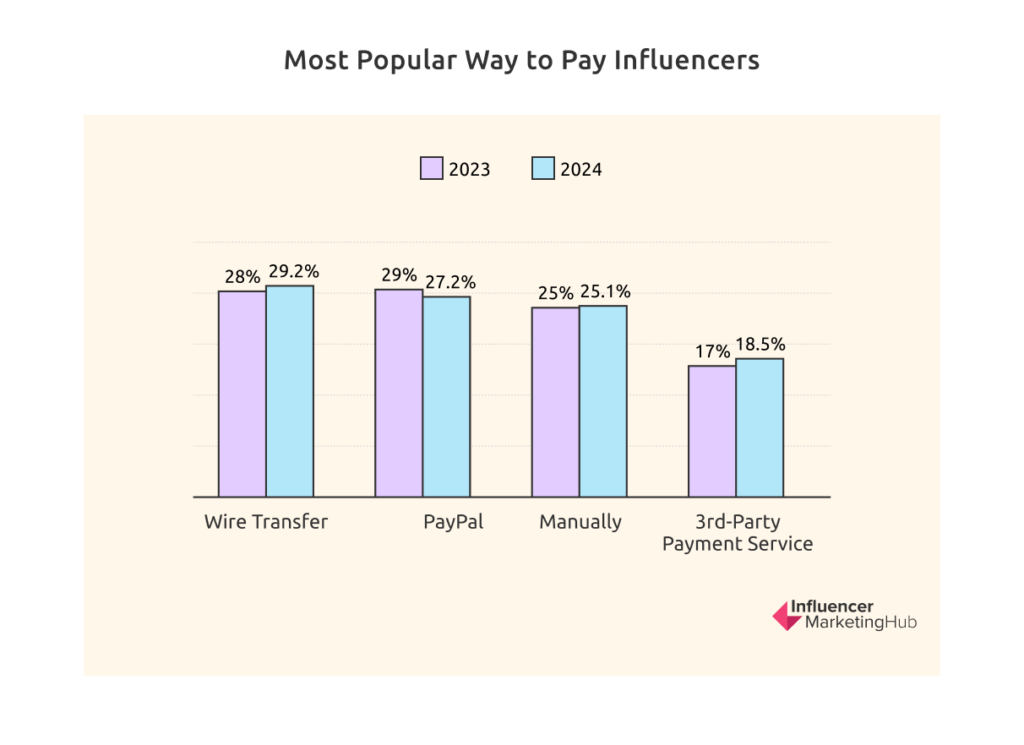
Payment methods depend very much on the location of the influencers. If they are based in a different country from where you operate, PayPal or something like Wise is much easier than a wire transfer or a manual transaction.
Nearly 80% of Brands Track Sales from Influencer Campaigns
Although there are many potential goals for an influencer marketing campaign, ...

Comments
Post a Comment